
Is Boxing Good for Kids? What Miami Parents Should Know
Miami Parents Ask
Is Boxing Good for Kids?
What Miami parents should know before enrolling
The Short Answer
Yes — when it’s taught by qualified coaches with a real curriculum, boxing is one of the best sports a kid can do. It builds full-body coordination, cardiovascular fitness, discipline, and confidence, and it teaches kids how to stay calm and think clearly under pressure.
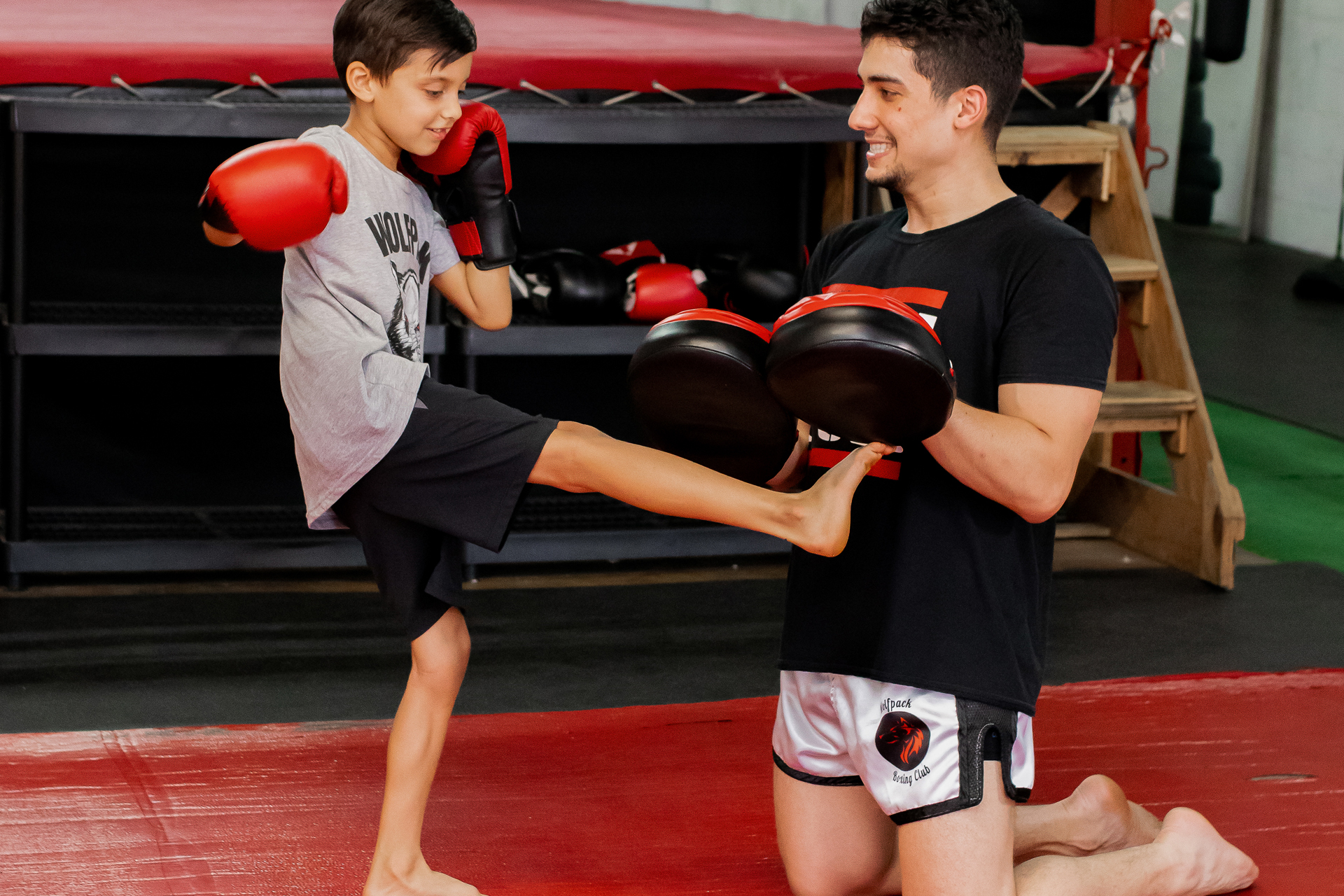
The risk most parents actually worry about — head contact — isn’t part of a well-run youth boxing program. At Wolfpack’s regular kids’ classes in Miami, kids learn technique on bags, mitts, and with partners. They don’t spar.
That last point is usually the first question a parent needs answered, so let’s start there before getting into the full picture of what boxing does for a kid physically, mentally, and socially.
Do Kids Spar or Get Hit in Boxing Class?
In a properly run kids’ program, no. Kids’ classes focus on technique: stance, footwork, punches, and defense, drilled on heavy bags, focus mitts, and in partner drills without contact. The goal at this age is building correct form and body awareness, not live sparring.
If a program has your child sparring in their first few weeks, that’s not a program built for kids. That’s an adult program with kids let in — and it’s worth asking direct questions about a gym’s actual kids’ curriculum before enrolling anywhere.
What Physical Benefits Does Boxing Give Kids?
Boxing is one of the more complete forms of physical development available to a young athlete, because it trains several systems at once instead of isolating one.
The CDC recommends kids get at least 60 minutes of moderate-to-vigorous physical activity daily. The CDC and AAP have also highlighted strength- and skill-based training as valuable additions to traditional aerobic activity for youth — a structured boxing class checks both boxes in a single hour.
What About the Mental and Emotional Benefits?
This is where boxing tends to outperform a lot of other youth activities. Boxing requires a kid to be fully present — you can’t zone out mid-round the way you might during a lap around a track. That builds focus. It also requires discipline: proper form only comes from repetition, and there’s no shortcut around doing the fundamentals correctly, over and over, class after class.
There’s a confidence component too, and it’s a specific kind of confidence. Not “I can beat someone up,” but “I know how to handle myself, and I don’t need to prove that to anyone.” Kids who train seriously tend to carry themselves differently: calmer, less reactive, less likely to escalate a conflict, because they’re not operating from anxiety about what would happen if something physical came up.
Common Myths About Kids and Boxing
“Boxing will make my kid aggressive.”
The opposite tends to be true. Structured training channels physical energy into a controlled, coached environment, and most programs spend more time on discipline and composure than on anything resembling aggression. A kid who’s actually training under a real coach learns restraint before they learn power.
“My kid isn’t athletic enough for boxing.”
Boxing is one of the more forgiving sports to start from zero in, because so much of the early curriculum is footwork and fundamentals rather than raw athleticism. Coordination and conditioning develop through the training itself.
“It’s only for kids who want to fight competitively.”
Most kids in a youth boxing program never compete. They’re there for fitness, discipline, and self-defense skill — the same reasons a kid might do gymnastics or swim team.
Is Boxing Safe for Kids Compared to Other Youth Sports?
Every physical sport carries some risk of injury. That’s true of soccer, gymnastics, and football as much as boxing. What actually determines safety is supervision and program design, not the sport itself. A kids’ boxing class run by experienced coaches, with age-appropriate drills and zero live sparring, carries a similar risk profile to most other structured youth athletics. The instruction quality is what matters most, more than the sport listed on the class schedule.
What Age Should a Kid Start Boxing?
Most programs, including Wolfpack’s kids’ classes, start around age 5 to 6, once a child can follow multi-step instructions and hold a stance long enough to drill it. Younger kids focus more on coordination, games-based conditioning, and the most basic fundamentals. Older kids and teens progress into full bag rounds, combinations, and more advanced technical work as their skill develops.
What to Look for in a Kids Boxing Program
Not every gym runs a real kids’ curriculum. A few questions worth asking before enrolling:
- Do the coaches have actual competitive fight experience, or is this a weekend certification hire?
- Is there a clear, structured curriculum, or is it improvised class to class?
- Is contact introduced gradually and appropriately for age, or is a young kid put in live drills too early?
- Can you see or track your kid’s progress over time?
The Bottom Line
Boxing is good for kids when it’s taught right: real coaches, real fundamentals, no shortcuts, no early contact. It builds a kind of fitness and composure that’s hard to get anywhere else, and it gives kids a real skill they can see themselves getting better at, week over week.
At Wolfpack Boxing Club
Kids’ classes are coached by trainers with actual competitive fight experience, not weekend certifications — including our founder Jake Poss, a former IKF World Champion.
Check Out Our Kids ProgramOr see our full class schedule to find a time that fits.
Homeschool family? We also run a dedicated homeschool boxing, PE & self-defense program during the school day, two days a week, with the same coaching standard, built around a homeschool schedule. If daytime classes don’t work for your family, our regular kids’ program is the fit instead.
FAQ
Is boxing good for kids?
Yes. Properly coached boxing builds cardiovascular fitness, coordination, discipline, and confidence, without live sparring at the youth level.
Do kids spar in boxing class?
No, not in a well-run youth program. Kids train technique on bags, mitts, and in non-contact partner drills.
What age can a kid start boxing?
Most programs start kids around age 5 to 6, with training scaled to their age and skill level.
Is boxing safer than other youth sports?
Risk depends more on coaching and program design than on the sport itself. A well-supervised kids’ boxing class has a risk profile similar to most structured youth athletics.
Does boxing make kids more aggressive?
No, the opposite is typical. Structured training builds discipline and composure, and most kids’ programs emphasize restraint and control well before any focus on power.